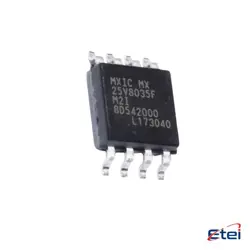
이미지는 참조용입니다.
24LC128T-I/ST
+BOMIC EEPROM 128KBIT I2C 8TSSOP
-
제조업체마이크로칩 기술
-
제조업체 부품 #24LC128T-I/ST
-
데이터시트 24LC128T-I/ST DataSheet
-
패키지 TSSOP-8
-
재고4506
365 1일 품질 보증
7*24 영업 시간 서비스 보증
90-판매 후 1일 보증
정품 보증
사양
| 속성 | 가치 |
| Package / Case | Tape & Reel (TR),Cut Tape (CT) |
| Part Status | Active |
| Memory Type | Non-Volatile |
| Memory Format | EEPROM |
| Technology | EEPROM |
| Memory Size | 128Kb (16K x 8) |
| Memory Interface | I²C |
| Clock Frequency | 400 kHz |
| Write Cycle Time - Word Page | 5ms |
| Access Time | 900 ns |
| Voltage - Supply | 2.5V ~ 5.5V |
| Operating Temperature | -40°C ~ 85°C (TA) |
| Mounting Type | Surface Mount |
개요
Description
This EEPROM operates over a voltage range of 2.5V to 5.5V and features a low power consumption design, making it suitable for battery-operated devices. Its design includes features like page write capability of up to 64 bytes per page and a data retention period of over 200 years. The device offers more than 1 million erase/write cycles, ensuring durability for extensive usage.
The 24LC128T-I/ST is housed in an 8-pin SOIC (Small Outline Integrated Circuit) package, providing a compact solution. It is often employed in applications requiring reliable and non-volatile memory storage, such as consumer electronics, industrial equipment, and automotive systems, where data preservation without power is crucial.
Equivalent
1. Atmel/Microchip AT24C128: A similar 128Kb I2C EEPROM.
2. STMicroelectronics M24C128: An I2C 128Kb EEPROM option.
3. ON Semiconductor CAT24C128: Another 128Kb I2C EEPROM alternative.
4. ROHM BR24G128: Offers similar functionality with 128Kb capacity.
These equivalents are suitable for applications requiring I2C EEPROM with similar specifications. Always verify pin configurations and electrical characteristics for compatibility.
Features
1. Memory Capacity: 128Kb organized as 16,384 x 8 bits.
2. Interface: I2C (Inter-Integrated Circuit) bus interface, supporting standard (100 kHz), fast (400 kHz), and fast-plus (1 MHz) modes.
3. Voltage Range: Operates with a supply voltage range of 1.7V to 5.5V.
4. Low Power Consumption: Offers low standby current and read/write currents.
5. Page Write Capability: Supports up to 64-byte page write.
6. Endurance and Retention: Provides over 1 million erase/write cycles per byte and data retention of over 200 years.
7. Package: Available in an 8-pin SOIC package.
8. Operating Temperature: Industrial temperature range from -40°C to +85°C.
9. Data Protection: Features include hardware write protection.
10. Sequential Read: Allows for sequential read operations.
These features make it suitable for applications requiring reliable non-volatile memory storage, such as consumer electronics, automotive systems, and industrial devices.
Pinout
The 24LC128T-I/ST comes in an 8-pin SOIC (Small Outline Integrated Circuit) package. The pin functions are as follows:
1. A0, A1, A2: These are address pins used to select the hardware address of the device. They allow for multiple EEPROM devices to be used on the same bus.
2. Vss: Ground connection for the device.
3. SDA (Serial Data): This pin is used for bidirectional data transfer between the EEPROM and the microcontroller or processor.
4. SCL (Serial Clock): The clock input for the I2C bus. It is used to synchronize data transfer.
5. WP (Write Protect): This pin is used to enable or disable write operations to the EEPROM.
6. Vcc: Power supply pin, typically 2.5V to 5.5V.
This EEPROM is used for storing data that needs to be retained even when power is lost, such as configuration settings or calibration data.
Manufacturer
Application
1. Consumer Electronics: Used for storing user settings and configuration data.
2. Industrial Automation: Ideal for data logging and storing calibration data.
3. Medical Devices: Utilized for storing patient records and device settings.
4. Automotive: Employed in vehicle infotainment systems and for configuration storage.
5. Computer Peripherals: Stores firmware and configuration data in printers and scanners.
6. Communication Systems: Used for network and telecom equipment settings.
7. Smart Devices: Stores configuration and operational data in IoT devices.
These applications leverage its non-volatile memory, low power consumption, and ease of integration with microcontrollers.