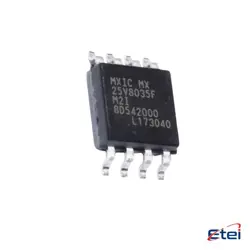
이미지는 참조용입니다.
MC68882EI40A
+BOMIC FLOATING-POINT CO-PROC 68PLCC
-
제조업체은지포미국주식회사
-
제조업체 부품 #MC68882EI40A
-
데이터시트 MC68882EI40A DataSheet
-
패키지 LCC-68
-
재고3122
365 1일 품질 보증
7*24 영업 시간 서비스 보증
90-판매 후 1일 보증
정품 보증
사양
| 속성 | 가치 |
| Package / Case | Tube |
| Part Status | Obsolete |
| Type | Floating-Point Co-Processor |
| Mounting Type | Surface Mount |
개요
Description
Operating at 40 MHz, the MC68882EI40A significantly speeds up mathematical calculations, making it ideal for scientific, engineering, and graphical applications that require intensive numeric computations. It supports IEEE 754 standard for floating-point arithmetic and offers extended precision with 80-bit floating-point registers, ensuring high accuracy and precision in calculations.
The coprocessor interfaces seamlessly with the host CPU and can be integrated into existing systems without major architectural changes. Typically used in applications that demand high numeric processing power, the MC68882EI40A is valued for its ability to offload complex math tasks from the main CPU, resulting in better overall system performance and efficiency.
Equivalent
1. MC68881 - The predecessor with similar functionality but less performance.
2. Intel 80387 - Intel's equivalent coprocessor for their line of processors.
3. Weitek 3167 - Another compatible math coprocessor.
4. Cyrix 83D87 - A third-party alternative offering similar capabilities.
These chips are used to enhance the floating-point computational performance in systems that support them.
Features
1. Performance: It significantly boosts the efficiency of floating-point arithmetic operations, such as addition, subtraction, multiplication, and division.
2. Compatibility: Seamlessly integrates with the 68020 and 68030 CPUs, enhancing computational capabilities without requiring major changes to existing systems.
3. Precision: Supports both single and double-precision arithmetic as defined by the IEEE 754 standard, enabling accurate scientific and engineering calculations.
4. Instruction Set: Offers a rich instruction set specifically optimized for floating-point operations, making it suitable for applications requiring complex mathematical computations.
5. Clock Speed: Operates at a clock speed of 40 MHz, providing significant processing power for demanding applications.
6. Packaging: Available in a ceramic PGA (Pin Grid Array) package, which aids in heat dissipation and offers robust physical durability.
7. Applications: Ideal for use in high-speed computing applications such as computer graphics, simulations, and data analysis.
Overall, the MC68882EI40A enhances system performance by offloading floating-point computations from the main CPU.
Pinout
Pin Count:
- The MC68882 typically comes in a ceramic PGA (Pin Grid Array) package with a pin count of 68.
Key Functions:
- The coprocessor performs arithmetic operations, including addition, subtraction, multiplication, division, and square root calculations.
- It supports single, double, and extended precision floating-point data formats.
- It enhances the performance of the host CPU by offloading complex mathematical computations, thereby speeding up applications that require intensive mathematical processing.
- The MC68882 is compatible with IEEE 754 floating-point standards.
Overall, the MC68882EI40A is a specialized component aimed at improving the efficiency and speed of floating-point calculations in computing systems, particularly in applications requiring high precision and quick execution of mathematical operations.
Manufacturer
Motorola initially split into two separate entities in 2011: Motorola Mobility and Motorola Solutions. Motorola Mobility focused on consumer electronics, particularly smartphones, and was acquired by Google and later by Lenovo. Motorola Solutions, on the other hand, concentrated on communications equipment and public safety technologies.
The semiconductor division of Motorola that developed products like the MC68882 was spun off as Freescale Semiconductor in 2004. Freescale itself was later acquired by NXP Semiconductors in 2015. Hence, the legacy of Motorola’s semiconductor business continues under NXP, a company specializing in automotive, industrial, and IoT applications, among others.