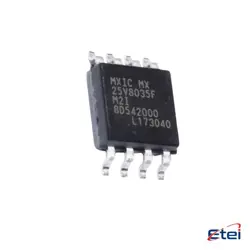
이미지는 참조용입니다.
TJF1052IT/5Y
+BOMDGTL ISOLTR 5KV 2CH CAN 16-SOIC
-
제조업체은지포미국주식회사
-
제조업체 부품 #TJF1052IT/5Y
-
재고2737
365 1일 품질 보증
7*24 영업 시간 서비스 보증
90-판매 후 1일 보증
정품 보증
사양
| 속성 | 가치 |
| PartStatus | Active |
| Technology | Capacitive Coupling |
| Type | CAN |
| IsolatedPower | No |
| NumberofChannels | 2 |
| Inputs-Side1/Side2 | 1/1 |
| ChannelType | Unidirectional |
| Voltage-Isolation | 5000Vrms |
| CommonModeTransientImmunity(Min) | 20kV/µs |
| DataRate | 2Mbps |
| Voltage-Supply | 3V ~ 5.25V |
| OperatingTemperature | -40°C ~ 105°C |
| MountingType | Surface Mount |
| Package/Case | 16-SOIC (0.295", 7.50mm Width) |
| SupplierDevicePackage | 16-SO |
| BaseProductNumber | TJF1052 |
개요
Description
"TJF1052IT/5Y" appears to be a specific course code or module identifier, possibly related to an academic or training program. However, without specific details about the institution or program, it's challenging to provide an exact description. Typically, these kinds of course codes follow a particular institutional naming convention, where:
- TJF might refer to a department, such as Technology, Journalism, or a specific faculty's abbreviation.
- 1052 could denote the course number, indicating its level or sequence within a curriculum.
- IT usually stands for Information Technology, suggesting the course content might focus on subjects related to computing, software, or digital systems.
- 5Y might refer to the course duration, year level, or a specific version or batch of the course.
If you have access to the syllabus or course description, it would provide further details about the course objectives, content, prerequisites, and evaluation methods. For specific information, consulting the institution's course catalog or website is recommended.
- TJF might refer to a department, such as Technology, Journalism, or a specific faculty's abbreviation.
- 1052 could denote the course number, indicating its level or sequence within a curriculum.
- IT usually stands for Information Technology, suggesting the course content might focus on subjects related to computing, software, or digital systems.
- 5Y might refer to the course duration, year level, or a specific version or batch of the course.
If you have access to the syllabus or course description, it would provide further details about the course objectives, content, prerequisites, and evaluation methods. For specific information, consulting the institution's course catalog or website is recommended.
Equivalent
The TJF1052IT/5Y is a robust CAN transceiver. Equivalent products include the NXP TJA1051/3/1, Microchip MCP2561/2, and ON Semiconductor NCV7351. These components provide similar CAN bus communication functionalities and are used in automotive and industrial applications to facilitate data transfer across CAN networks. Always verify compatibility with specific requirements before substituting components.
Pinout
The TJF1052IT/5Y is a CAN (Controller Area Network) transceiver, typically used in automotive and industrial applications for data communication. This device comes in an 8-pin package, although the specific pin configuration might vary slightly depending on the manufacturer.
Here is a general description of the pin functions:
1. TXD (Transmit Data Input): Input pin for data to be sent over the CAN bus.
2. RXD (Receive Data Output): Output pin for receiving data from the CAN bus.
3. VCC (Supply Voltage): Power supply pin for the transceiver.
4. GND (Ground): Ground reference for the transceiver.
5. CANH (CAN High): High-level voltage bus line connected to the CAN network.
6. CANL (CAN Low): Low-level voltage bus line connected to the CAN network.
7. STB (Standby Control): Used to put the transceiver into standby mode for low power consumption.
8. RS (Slope Control/Mode Select): Controls the slew rate for reduced EMI or to change the mode of operation.
For exact details, referring to the manufacturer's datasheet is recommended.
Here is a general description of the pin functions:
1. TXD (Transmit Data Input): Input pin for data to be sent over the CAN bus.
2. RXD (Receive Data Output): Output pin for receiving data from the CAN bus.
3. VCC (Supply Voltage): Power supply pin for the transceiver.
4. GND (Ground): Ground reference for the transceiver.
5. CANH (CAN High): High-level voltage bus line connected to the CAN network.
6. CANL (CAN Low): Low-level voltage bus line connected to the CAN network.
7. STB (Standby Control): Used to put the transceiver into standby mode for low power consumption.
8. RS (Slope Control/Mode Select): Controls the slew rate for reduced EMI or to change the mode of operation.
For exact details, referring to the manufacturer's datasheet is recommended.
Manufacturer
The TJF1052IT/5Y is manufactured by Olympus Corporation. Olympus is a Japanese multinational company that primarily operates in the fields of optics and reprography. It is well-known for its innovative products in various domains, including medical equipment, scientific solutions, and consumer electronics. In the medical sector, Olympus is renowned for its endoscopic and imaging devices, which are widely used in healthcare facilities around the world. The TJF1052IT/5Y, being part of their medical device lineup, is likely related to their endoscopic equipment offerings.
Application
The TJF1052IT/5Y is typically used in industrial and commercial applications. It is suitable for power management systems, motor control, and automation due to its robust design and reliable performance. This component is often utilized in environments requiring efficient energy distribution and conversion, such as renewable energy systems, manufacturing plants, and transportation infrastructure. Its durability and adaptability make it ideal for high-demand scenarios requiring consistent operational efficiency and safety.